Our democracy is under attack. It started very slowly with the introduction of the internet into our homes. At first, it was not evident and people generally trusted whatever was online: content was made by other real humans, and humans had good intentions. Even Google once had the slogan "Don't Be Evil" as part of their code of conduct, however, it got eventually removed from it. The 90s and 2000s were a time where trust was never questioned. Why would we need to worry about that, when we can connect with our friends and family via social networks and upload all our data there? What's the worst thing that can happen?
One Database to Rule Them All
In 2012, Facebook reported a user count of 1 Billion accounts, basically 1/7th of the world's total population in 2012. This meant that one single company had full ownership of all data (including private chats) and they probably never got rid of that data. The danger here is that this data can be analysed, studied and used to drive the interests of the few that hold control over that data. Hence, the more data an individual can hoard, the more power and influence they get overall. By giving this much data (and power) to individuals like that, we are contributing to the creation of propaganda machines, networks of bots, that can drive and control public discouse by manipulating algorithmic social feeds. Facebook has been under fire for this already but with the acquisition of Instagram and their current efforts to train their own LLMs on the data they hoard, there does not seem to be a slowdown of their influence. Now, there is not just Facebook (Meta) of course, but many other large companies those objective it is to hoard as much data as possible and get people hooked to their algorithmic social feeds.
Breaking the power apart
The solution to this dilemma is actually rather simple: instead of giving our data to a single entity, we all should spread the data across many small providers. With a system like this, we could still enjoy social networks like we are used to and upload videos and photos as much as we like, without fearing that a single entity will accumulating this much power and control over our daily digital routine: it's called the Fediverse!
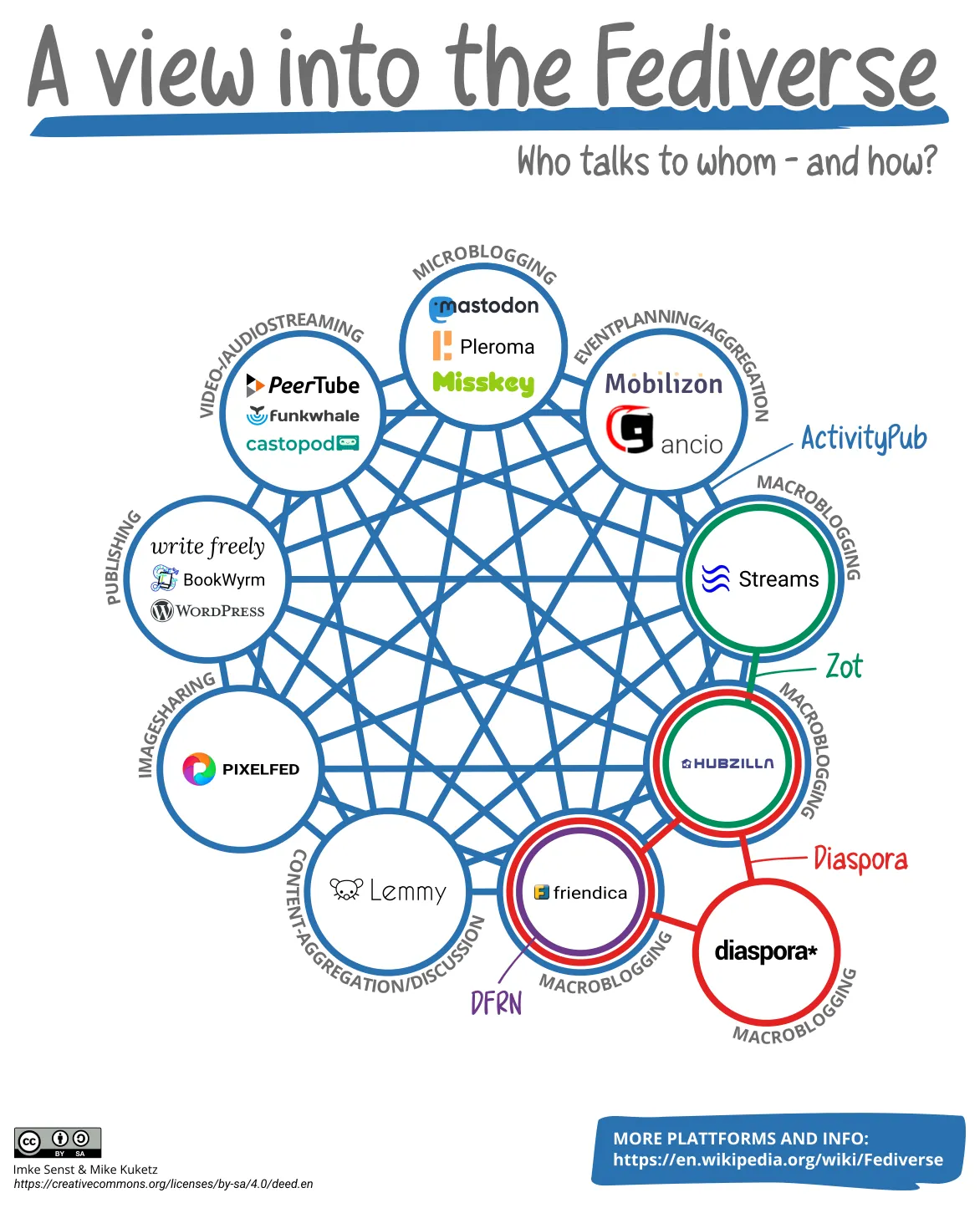
Services like Youtube, Facebook and Twitter all get an open-source alternative that runs on the Fediverse. For example, I use Mastodon, which is a Twitter alternative that does not suffer from algorithmic timeline feeds and it solves one major problem that the internet currently suffers from: there are hundreds of servers one can join and therefore power gets distributed among them.
Mastodon.social controversy
Now, I gotta call out the elefant in the room (pun intended): you may notice that as of 2026, Mastodon's main website looks like this: 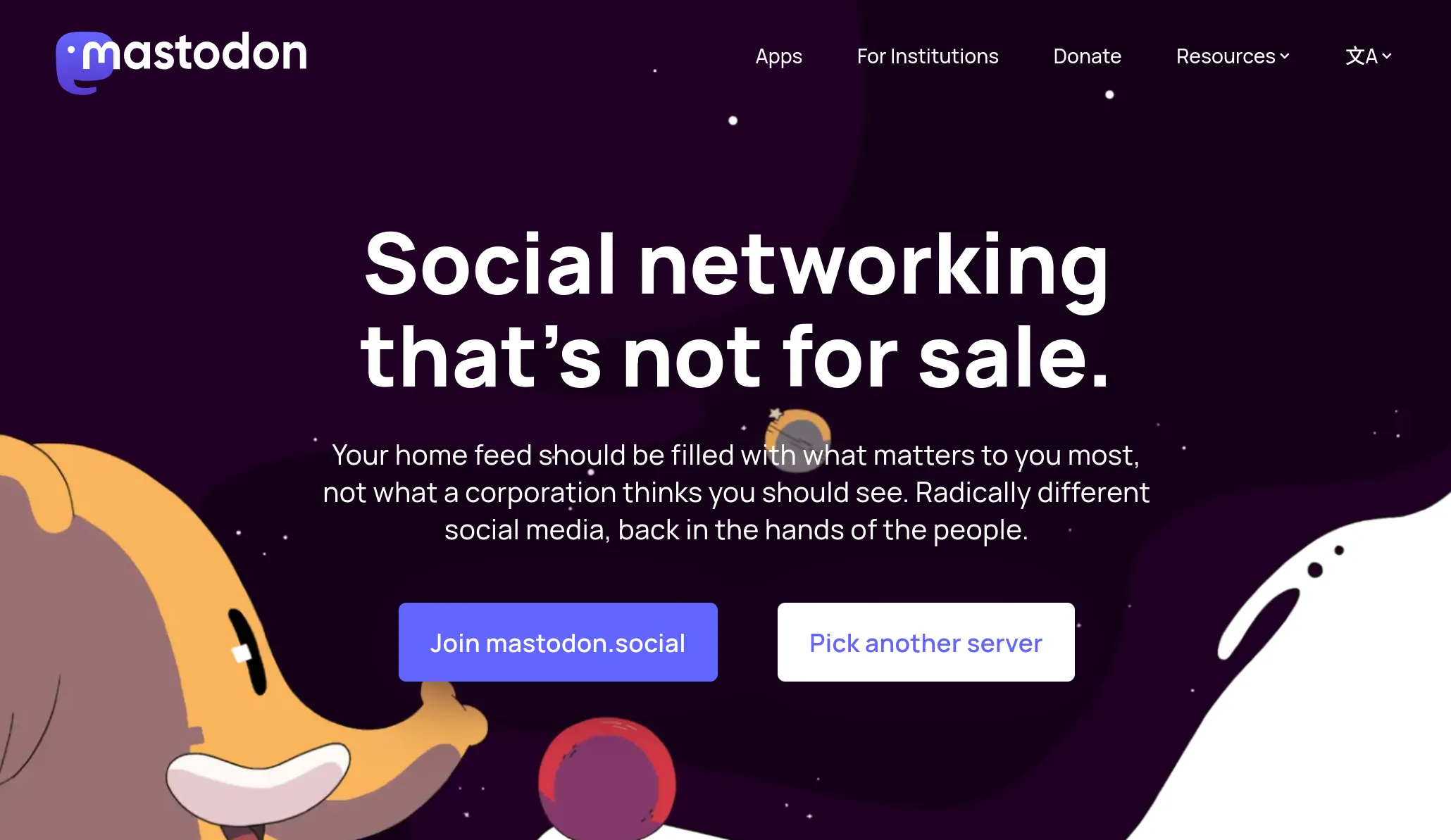
Where do you think the average internet user will click on? Correct: the big primary button that says "Join mastodon.social". "So what?" you may ask... well, let's remember the whole point of the Fediverse: the goal is to disperse power. As the time of writing this blog post, that server alone hots 30% of all Mastodon accounts, according to fedi.tips. This is a massive issue because this means that whoever owns that specific database has a much larger influence and power compared to other servers. They could decide to block certain content or change the rules of that specific instance and it would affect 30% of all Mastodon users. Not that this is something that would actually happen, given the server is maintained by the actual maintainers of Mastodon, however the goal here is to disperse power, not to bundle it. So please, if you decide to join Mastodon, avoid mastodon.social and use a different server instead!
Protecting Democracy
Now that the basics are out of the way, let's focus on the topic at hand: we have to protect democracy at all cost. Let's say a billionare wanted to influence every person on the Fediverse. What could they do? Well, for starters they could launch a set of new servers and sign up bot accounts that spread fake information. In a centralised social network like Twitter or Facebook, this most of the time completely gets unchecked and bots need to be banned on a case-by-case basis. This is extremely inefficient and difficult to control. However, on the Fediverse, entire instances can be completely blocked, effectively "shadow banning" those bots without even the server owner realising that their content is not seen any longer. This is extremely powerful and should be the defacto standard of social networking in 2026. Unfortunately, many people still don't even know about the Fediverse and to be frank, they might not even care enough yet. That being said, the Fediverse provides some great foundations to protect democracy and fight against propaganda.
What is truth?
One issue that remains even with the Fediverse is the verification of information. How do we decide that information we see online is actually true? Truth itself also changes depending on whom you ask. That's a story for another day, as I have some thoughts on that topic specifically.
Rather than detecting "fake news" we can highlight information that actually is verifiable and has some trusted sources. There are already projects in that direction that allow publishers of photos, videos and articles to ship a fingerprint with that source in their metadata to "stamp" the data as theirs. However, that approach on its own is not very reliable. To expand this concept I had some additional ideas but that shall be discussed in a future blog post.
See you all on the Fediverse!